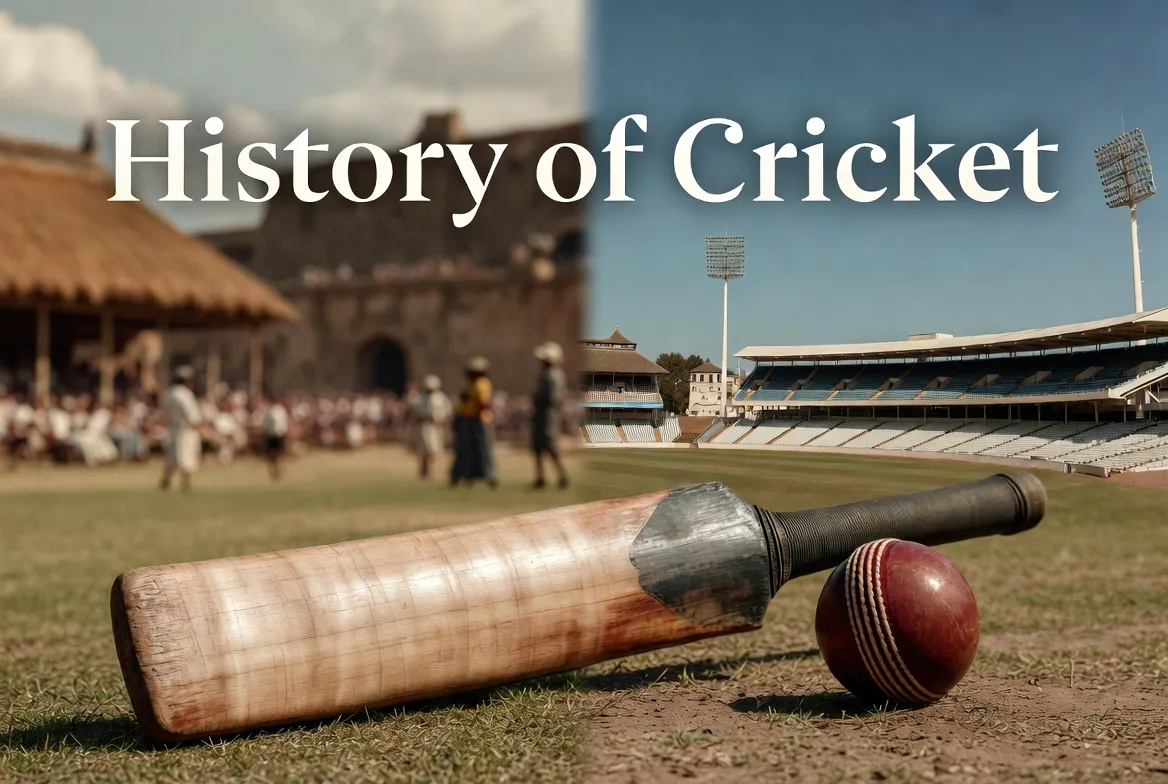
Cricket is one of the world's oldest organised sports, with origins going back at least 800 years to medieval England. From a children's game played with crooked sticks, it evolved into a structured sport with formal rules, then spread across the British Empire to become a global game played by billions. The first international match was held in 1844, the first Test match in 1877, the first World Cup in 1975, and the first T20 international in 2005. Here is the complete timeline of how cricket became the game we know today.
Early Origins: 13th to 16th Century
The earliest references to cricket appear in 1300s England. A 1598 court case in Guildford, Surrey, mentions men playing "krickett" on common land as children in the 1550s. The game likely originated from rural pastimes where shepherds and farmers used:
Crooked sticks as bats (similar to hockey sticks)
Wooden balls or wool-wrapped stones
Tree stumps or gates as the early form of wickets
The word "cricket" itself may come from the Old English "cryce" meaning a crooked staff, or possibly from the Dutch "krick" meaning a small stick.
The First Formal Rules: 1744
Cricket's defining moment came in 1744, when the first written Laws of Cricket were codified. These early laws established:
The 22-yard pitch length
The principle of overs (initially 4 balls per over)
The wicket structure
The basic methods of dismissal
By the late 1700s, cricket was firmly established as the gentleman's summer sport across England. The Marylebone Cricket Club (MCC), founded at Lord's in 1787, became the official guardian of the Laws of Cricket, a role it still holds today.
Cricket Spreads Across the Empire
British colonisation took cricket worldwide in the 18th and 19th centuries:
Country | Cricket Established |
|---|---|
England | 1600s (original) |
India | Early 1700s (English East India Company) |
Australia | 1803 (first recorded match) |
West Indies | 1800s |
South Africa | 1808 (first match in Cape Town) |
New Zealand | 1832 |
Pakistan | Pre-1947 as part of British India |
Sri Lanka | 1800s as Ceylon |
Cricket's spread was uneven. It took root deeply in some colonies, especially the Indian subcontinent, Australia, and the Caribbean, while other British territories preferred different sports.
The First International Match: 1844
The first recorded international cricket match was played in 1844 between USA and Canada, in New York. The match predates the first Test match by 33 years. The USA actually beat Canada, but international cricket in North America fizzled out as baseball became the dominant bat-and-ball sport.
The First Test Match: 1877
Test cricket began in March 1877 in Melbourne, when Australia hosted England. Australia won by 45 runs. This match retroactively became known as the first Test, and the format gave its name to the rivalry that became The Ashes in 1882, after a famous English defeat at The Oval.
Test cricket grew slowly:
1877: First Test, Australia vs England
1889: South Africa become the third Test nation
1928: West Indies, New Zealand, and India admitted in subsequent years
1952: Pakistan plays its first Test
1982: Sri Lanka admitted
1992: Zimbabwe admitted
2000: Bangladesh admitted
For the full breakdown of how Test cricket differs from other formats today, see our cricket formats explained guide.
The Modern Equipment Era
Cricket equipment evolved alongside the sport:
1700s: Curved bats replaced by straight bats
1864: Overarm bowling legalised (previously underarm)
1900s: Standardised ball weight and dimensions
1970s: Helmets introduced after several serious injuries
2010s: BS 7928 helmet safety standards
2014: Neck guards introduced after the death of Phillip Hughes
The cricket ball itself has remained remarkably consistent in design since the 1700s, see our guide on what a cricket ball is made of for the construction details that still apply today.
The One Day International Era: 1971
The first One Day International (ODI) was played in January 1971 in Melbourne, between Australia and England. It was an emergency replacement after a Test was abandoned due to rain. The match was 40 overs per side and Australia won, sparking a new era in cricket.
By 1975, the first Cricket World Cup was held in England, with West Indies winning under Clive Lloyd. The ODI revolution permanently expanded cricket's commercial appeal and brought white balls, coloured clothing, and night matches into the game.
The T20 Revolution: 2003-2007
T20 cricket was created to attract younger audiences. The first T20 match was played in 2003 in English county cricket. The first T20 international was in February 2005, between New Zealand and Australia.
The first T20 World Cup was held in 2007 in South Africa. India beat Pakistan in the final, sparking a cricket revolution in the subcontinent. The Indian Premier League (IPL) launched in 2008 and became the wealthiest cricket competition in the world.
T20 changed everything:
Cricket reached new audiences through 3-hour matches
Player salaries rose dramatically through franchise leagues
Scoring rates increased across all formats
Strategic innovations like ramp shots and switch hits became common
Cricket Today
Modern cricket has more competition formats and players than at any point in history. The three main formats coexist, with:
Test cricket: Still considered the format that defines great players
ODIs: Major tournaments, World Cup every 4 years
T20s: Franchise leagues worldwide (IPL, BBL, PSL, CPL, SA20, The Hundred)
For how matches are timed across these formats today, our match duration guide covers the modern timings.
From experience: Cricket history matters because it explains the culture of the game. Wearing cricket whites in Tests is not just tradition, it is a link to the gentleman's sport era. The Ashes rivalry feels more intense because it has been going since 1882. Junior players who learn history alongside technique tend to develop a deeper love for the game. It is not just about runs and wickets, it is about being part of an 800-year story.
Famous Moments in Cricket History
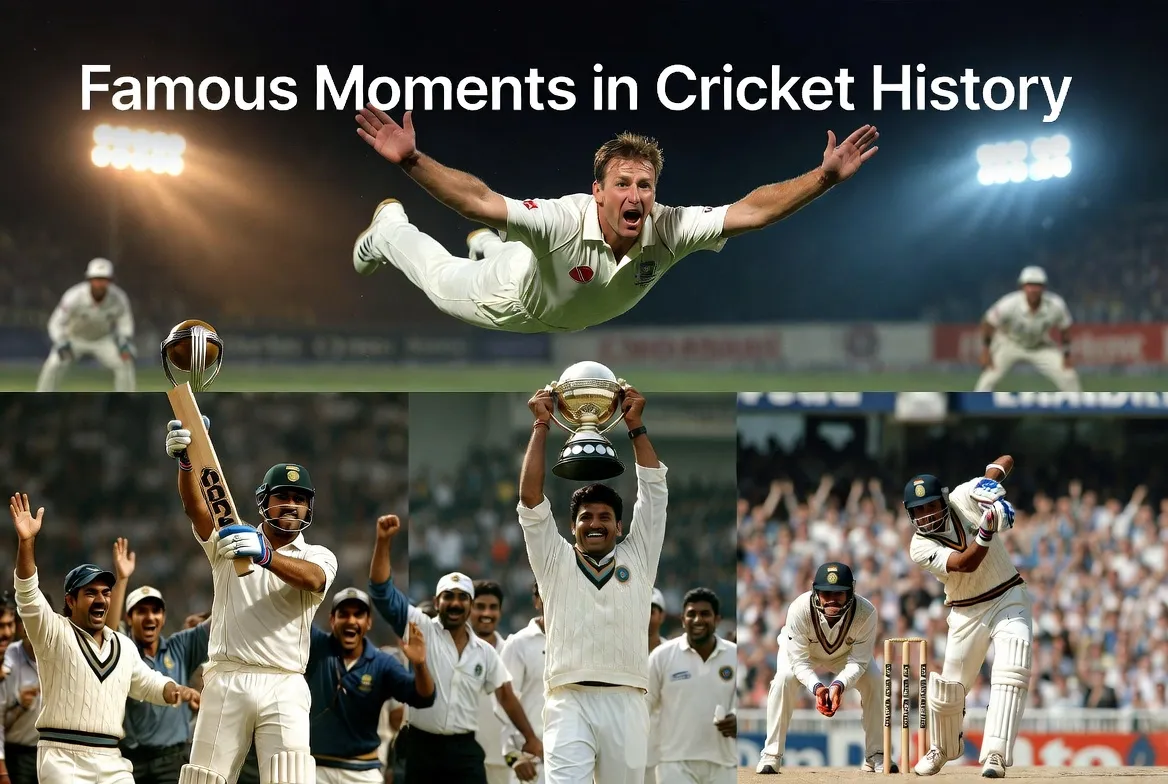
1882, The Oval: Australia beats England, the Sporting Times publishes the mock obituary that became The Ashes
1930, Australia: Don Bradman scores 309 runs in a single day at Leeds
1948, Australia: The Invincibles tour England undefeated, Bradman's last Test
1975, England: West Indies win first World Cup
1983, India: India shock West Indies in World Cup final at Lord's
1992, Australia: Pakistan beat England in the final and won the World Cup.
1996, Sri Lanka: First Asian country to win World Cup on home soil (Pakistan)
2005 Ashes: Greatest Test series of modern times, England wins 2-1
2014, Australia: Phillip Hughes dies, neck guards introduced
2019, England: First World Cup win for England at Lord's, super-over decision
2023, India: Australia win World Cup at Ahmedabad
Conclusion
Cricket's history stretches from medieval English shepherds to multi-billion-dollar T20 franchises. The 22-yard pitch, the cork-and-leather ball, the willow bat, and the basic structure of innings have remained consistent for centuries even as the surrounding game has transformed. Understanding the history makes watching modern cricket richer, every Test match echoes 1877, every six in T20 builds on the legacy of bat-and-ball games from rural England 800 years ago.
FAQs
When was cricket invented?
References go back to the 13th century in England, but the first recorded match was in 1646. Formal rules were codified in 1744.
When was the first Test match?
March 1877, in Melbourne, Australia vs England. Australia won by 45 runs.
When was the first Cricket World Cup?
1975, hosted in England. West Indies won, beating Australia in the final at Lord's.
When did T20 cricket start?
The first professional T20 match was in 2003 in English county cricket. The first T20 international was in 2005 between New Zealand and Australia.