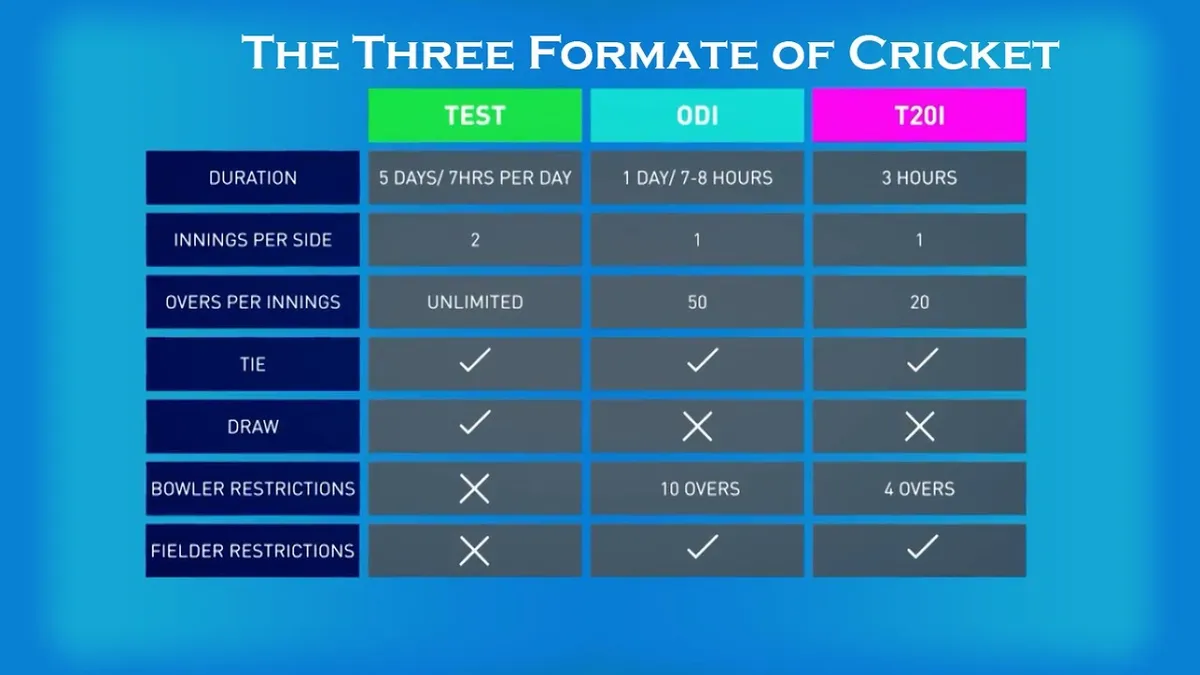
Cricket has three main formats: Test, ODI (One Day International), and T20 (Twenty20). The core rules stay the same - bowler bowls, batter bats, fielders field - but the number of overs, match duration, and strategy change dramatically between formats. Test cricket rewards patience and technique over five days. ODIs balance endurance with aggression over 50 overs per side. T20 is pure entertainment in under 3 hours. Here is how they compare and what makes each format unique.
Test vs ODI vs T20: Quick Comparison
Feature | Test Cricket | ODI | T20 |
|---|---|---|---|
Overs per side | Unlimited | 50 | 20 |
Innings per side | 2 | 1 | 1 |
Duration | Up to 5 days | ~8 hours | ~3 hours |
Ball colour | Red (day), Pink (day-night) | White | White |
Clothing | Whites | Coloured kits | Coloured kits |
Powerplay overs | None | 3 powerplays | 1 powerplay (6 overs) |
Result options | Win, lose, draw, tie | Win, lose, tie, no result | Win, lose, tie, Super Over |
Bouncer limit | No limit | 2 per over | 2 per over |
Fielding restrictions | None | Yes (powerplay phases) | Yes (powerplay + max fielders outside circle) |
Test Cricket - The Original Format
Test cricket is the oldest and longest format, played over a maximum of 5 days with 90 overs bowled per day. Each team bats twice, and there is no limit on how many overs a side can face. A match can end in a win, loss, draw, or tie - and yes, draw and tie are different things.
A draw happens when time runs out before both teams complete their innings. A tie happens when both teams are all out with exactly the same score - this has only happened twice in over 2,500 Test matches.
The red ball (or pink in day-night Tests) swings and seams more than the white ball, which is why fast bowlers dominate early sessions. Test cricket uses no fielding restrictions, so captains can set fully attacking or fully defensive fields.
From experience: I played multi-day cricket at district level, and the shift in mentality from white-ball to red-ball is massive. In T20 you are thinking shot-per-ball. In longer formats, you learn to respect good deliveries and wait for the bad ones. That patience is what separates club players from those who move up.
ODI Cricket - The 50-Over Game
ODIs give each side 50 overs to bat, making the total match length around 8 hours. The format was introduced in 1971 and became the foundation for World Cup cricket.
ODIs use three powerplay phases:
Powerplay 1 (overs 1-10): Only 2 fielders allowed outside the 30-yard circle
Powerplay 2 (overs 11-40): Maximum 4 fielders outside the circle
Powerplay 3 (overs 41-50): Maximum 5 fielders outside the circle
Scoring rates in ODIs have changed dramatically. In the 1990s, 250 was a competitive total. Today, teams regularly chase 300+, and totals above 350 are not safe. This is partly because bats are better, boundaries are shorter, and batting techniques have evolved through T20 influence.
T20 Cricket - The Fast Format
T20 gives each side just 20 overs, finishing a match in roughly 3 hours. The first international T20 was played in 2005, and it changed cricket forever.
The format has its own rules:
1 powerplay of 6 overs (max 2 fielders outside the circle)
Each bowler can bowl a maximum of 4 overs
Free hit after every no ball (also applies in ODIs since 2015)
Super Over decides tied matches - each team faces 6 balls, highest score wins
T20 has spawned franchise leagues worldwide - the IPL, Big Bash, CPL, PSL, SA20, The Hundred - making it the most commercially successful format.
Which Format Is Best for New Fans?
If you are new to cricket, start with T20. The matches are short, the action is constant, and you will understand the overs structure quickly. Once you appreciate the basics, watch ODIs for deeper strategy. Then try Test cricket - it is slower, but once you understand the tactical battle between bat and ball, nothing else compares.
How Formats Affect Player Strategy
Skill | Test Approach | ODI Approach | T20 Approach |
|---|---|---|---|
Batting | Occupy crease, build innings | Rotate strike, accelerate late | Attack from ball one |
Bowling | Pitch it up, swing/seam, patience | Yorkers at death, variations | Slower balls, wide yorkers, deception |
Fielding | Slips, close catchers | Athletic ground fielding | Boundary riders, diving saves |
Key dismissal | LBW, caught behind | Caught in deep | Caught at boundary |
Conclusion:
All three formats are cricket, but they demand completely different skills and mindsets. Test cricket is the ultimate examination of technique and temperament. ODIs reward players who can adapt through a long innings. T20 is about fearless shot-making and high-pressure execution. Understanding the overs structure and match duration of each format will help you appreciate why the same player can dominate in one format and struggle in another.
FAQs
What is the most popular cricket format?
T20 is the most popular commercially due to franchise leagues like the IPL. Test cricket remains the most prestigious among players.
Can a Test match end in a draw?
Yes. If time runs out before both teams complete their innings, the match is drawn regardless of the score.
How many overs are bowled in each format?
Test: unlimited (90 per day), ODI: 50 per side, T20: 20 per side. Read the full breakdown in our overs explained guide.
Which format has the highest scoring?
T20 has the highest run rate (typically 8-10 runs per over), but Tests can produce the largest totals since innings are unlimited.