Cricket has a reputation for being complicated, but the basic rules are simple. Two teams of 11 players take turns batting and bowling. The batting team tries to score runs. The bowling team tries to take wickets. The team with more runs at the end wins. Everything else is detail on top of these three rules. This guide explains cricket from scratch, the basic structure, how scoring works, key rules every new fan needs to know, and the major formats.
The Basic Structure
A cricket match is built around innings. An innings is a single batting opportunity for one team. The format determines how many innings each team gets:
Format | Innings Per Team | Overs Per Innings |
|---|---|---|
Test | 2 | Unlimited |
ODI | 1 | 50 |
T20 | 1 | 20 |
Each over consists of 6 legal deliveries. For the full breakdown of how overs are structured across formats, see our guide on how many overs in cricket.
How Cricket Is Played?
Two teams. Eleven players each. On the field at any time:
The fielding side: All 11 players are on the field, including the bowler and wicketkeeper
The batting side: 2 batters are on the field. The rest wait their turn
The bowler delivers the ball from one end of the pitch. The batter at the other end (the striker) tries to hit it. If they score runs, they run between the wickets while the fielders try to get the ball back. If they are dismissed, a new batter comes in.
The innings ends when the batting side loses 10 wickets (meaning all but one batter is dismissed) or runs out of overs.
How Runs Are Scored?
Run: Batters run from one end of the pitch to the other. Each completed run is worth 1 run
Boundary (4): Ball reaches or crosses the boundary along the ground. Worth 4 runs
Six: Ball clears the boundary on the full (without bouncing). Worth 6 runs
Extras: Runs added without the bat, including wides, no balls, byes, and leg byes
How Wickets Are Taken?
There are 11 ways a batter can be dismissed. The most common are:
Bowled: The ball hits the stumps and dislodges a bail
Caught: A fielder catches the ball before it hits the ground
LBW (Leg Before Wicket): The ball strikes the batter's leg or body in line with the stumps. See our full guide on what is LBW in cricket
Run out: A fielder hits the stumps while the batters are running between wickets
Stumped: The wicketkeeper dislodges the bails when the batter is out of their crease
Rare dismissals include hit wicket, obstructing the field, timed out, and a few others.
The Pitch and Field
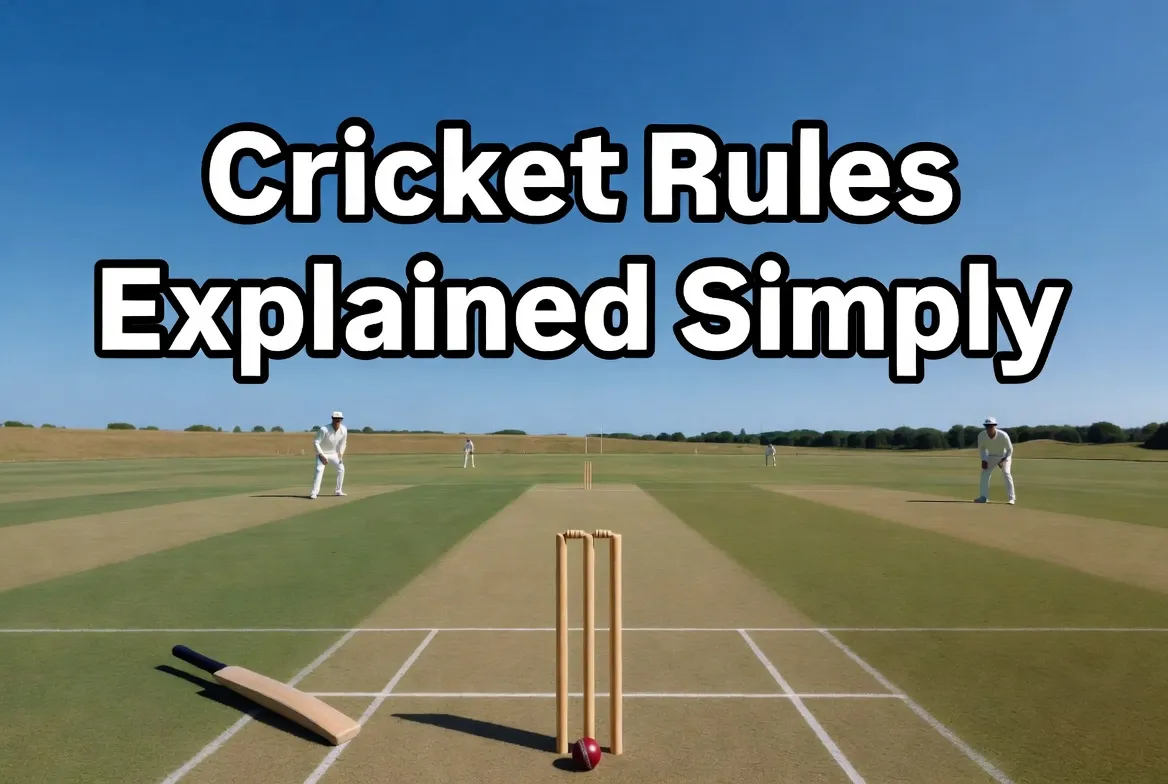
Cricket is played on an oval field with a rectangular pitch in the middle. The pitch:
22 yards (20.12 metres) long from stump to stump
10 feet (3.05 metres) wide
Has three stumps at each end with two bails on top
Marked with painted crease lines that define legal play
The boundary is typically 59-90 metres from the centre, with the exact size varying by ground.
Equipment
The basic cricket equipment includes:
A cricket bat: Made of English or Kashmir willow, sized to the player's height. See our bat size guide
A cricket ball: Red, white, or pink depending on format. Hand-stitched leather over a cork core
Stumps and bails: Three wooden stumps and two bails at each end of the pitch
Protective gear: Pads, gloves, helmet, abdominal guard, and other protection
Cricket shoes: Spikes or rubber soles depending on the playing surface
The Three Formats
Cricket has three main formats, each with different rules and rhythms:
Test cricket: Up to 5 days, 90 overs per day, 2 innings each, all white kit, red ball
ODI (One Day International): 50 overs per side, 1 innings each, coloured kit, white ball
T20 (Twenty20): 20 overs per side, 1 innings each, coloured kit, white ball
For the full comparison of all three, see our cricket formats explained guide.
How the Match Ends?
A match ends when:
The chasing team reaches the target score
The chasing team is bowled out for less than the target
The overs allocated to the chasing team are completed
Time runs out (in Test cricket only, this can result in a draw)
For exact timing rules and what causes delays, our guide on how long does a cricket match last covers it.
From experience: When new players ask about cricket rules, the trick is not to teach all 11 dismissal methods at once. Start with bowled, caught, and LBW. Add run out next. Everything else can come over time. The same applies to formats, start with T20 because it is short and constant, then move to ODIs, then Tests once you understand the strategy. Cricket is layered, but the foundation is simple.
Common Cricket Terms
Term | Meaning |
|---|---|
Wicket | Either the stumps or a dismissal |
Over | A set of 6 legal deliveries |
Crease | A line on the pitch that defines legal play |
Boundary | The outer edge of the field or a 4/6 hit |
Dot ball | A delivery with no run scored |
Maiden over | An over with zero runs scored |
Run rate | Runs per over scored or required |
Partnership | Runs scored by two batters together at the crease |
Credit: The Cricket Explainer
Conclusion
Cricket rules look complex but break down into a simple core: two teams, one tries to score runs, the other tries to take wickets, and whoever scores more wins. Once you understand runs, wickets, and the basic field layout, everything else, formats, dismissals, fielding restrictions, is detail you can pick up over time. The best way to learn is to watch matches alongside this guide. For deeper context on key rules, our guides on LBW, formats, overs, and match duration cover each area in detail.
FAQs
How do you play cricket?
Two teams of 11 take turns batting and bowling. The batting team scores runs by hitting the ball. The bowling team takes wickets to limit the score. The team with more runs wins.
How many players are in a cricket team?
11 per side. All 11 are on the field for the fielding team. Only 2 batters from the batting team are on the field at any time.
How long does a cricket match last?
T20: ~3 hours. ODI: ~8 hours. Test: up to 5 days. See our full guide on cricket match duration for details.
What is the easiest cricket format for beginners to watch?
T20. Short, constant action, and easy to follow the score. ODIs and Tests have more strategy but take longer.