Good cricket batting technique is built on four foundations: stance, grip, backlift, and footwork. Master these and almost every shot becomes possible. Get them wrong and even talented players plateau. The technique applied by professional batters is the same one used at junior level, only refined through years of repetition. This guide covers the core elements of batting technique and how to develop the major shots in cricket's stroke arsenal.
The Four Foundations of Batting
Element | What It Controls |
|---|---|
Stance | Balance, vision, readiness to move |
Grip | Bat speed, shot direction, hand control |
Backlift | Timing, power generation |
Footwork | Getting to the pitch of the ball |
Stance
A good stance sets up everything else. The key principles:
Feet roughly shoulder-width apart, parallel to the popping crease
Knees slightly bent, weight centred and ready to move
Head over the front foot or balanced between feet
Eyes level, looking down the pitch at the bowler
Bat tapping the ground between the feet, ready to lift
The stance does not have to be rigid. Some batters stand tall (Steve Smith, distinctly upright). Others crouch low (Marnus Labuschagne). What matters is balance and the ability to move into both forward and back foot shots quickly.
The Grip
The standard grip holds the bat with both hands close together, the V of each thumb and forefinger pointing down toward the back of the bat. Common grip principles:
Top hand controls direction: For a right-handed batter, the left hand (top hand) is the dominant guide
Bottom hand provides power: The right hand drives shots through the line
Hands close together: A spread grip reduces control
Firm but not tight: A death grip tenses arms and slows bat speed
For more detail on bat handling and how grip relates to bat size, the right grip changes depending on how heavy and long your bat is.
The Backlift
The backlift is how the bat moves up before coming down into the shot. A good backlift:
Lifts toward second slip (or close to it) rather than straight back
Stays high enough to give time to time the shot
Is consistent across all deliveries, the same backlift for defence and attack
Big backlifts generate more power. Smaller backlifts give more control. Most batters use a medium backlift, big enough for drives, small enough for late adjustment against pace.
Footwork
Footwork is the most underrated part of batting. The basic principle is to get to the pitch of the ball:
Forward foot: Move the front foot forward and toward the line of the ball for full-pitched deliveries
Back foot: Push back and across for short-pitched deliveries, giving yourself time
Stay on the back leg: For pulls and cuts, weight needs to be on the back foot
Poor footwork is what causes most batting dismissals at every level. LBW dismissals are often the result of playing on the back foot when forward movement was needed.
The Major Cricket Shots
Cover Drive
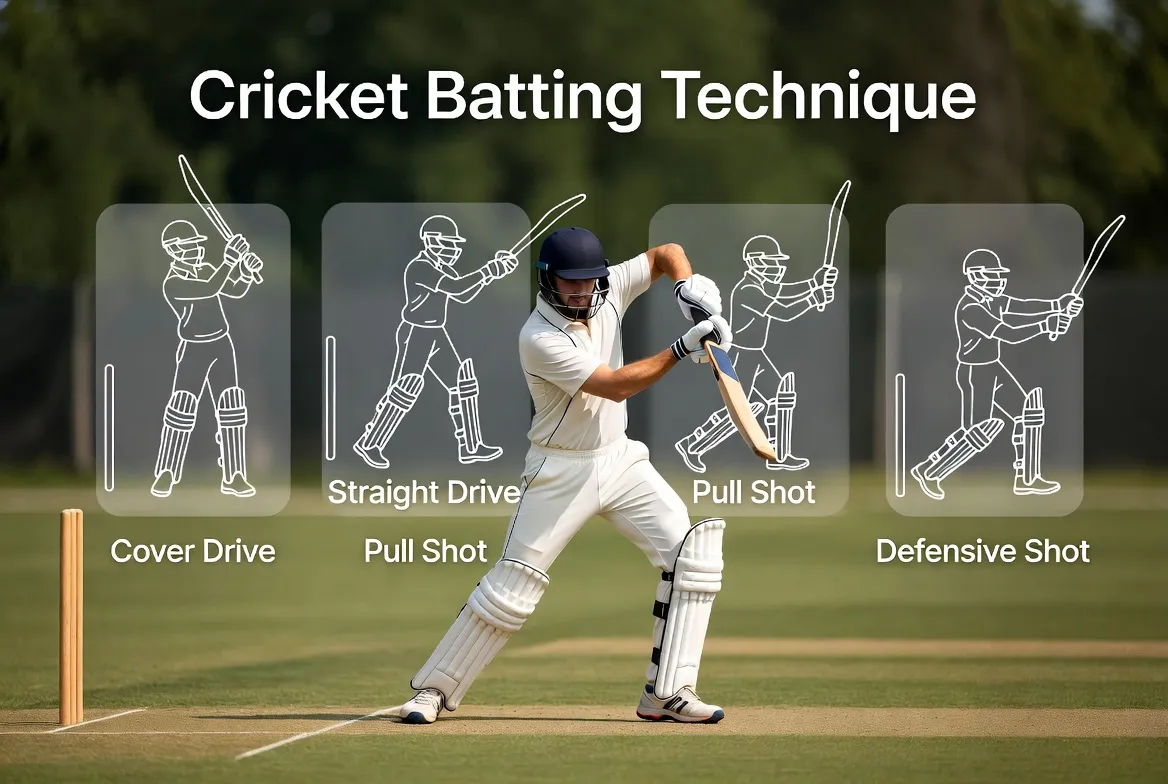
One of cricket's most aesthetic shots. Played to a full-pitched ball outside off stump. The front foot moves to the pitch of the ball, head over the ball, bat swings through the line toward extra cover. Power comes from timing, not muscle.
Straight Drive
Played to a full ball on or just outside off stump. The bat comes down straight, hands stay close to the body, and the ball is driven back past the bowler. Considered the textbook driving shot.
Square Drive
Wider than a cover drive, played squarer to the off side on a fuller ball. Useful when the bowler pitches up and wide.
Pull Shot
Played to a short ball on or around middle stump. Back foot moves across, weight transfers, and the bat comes through horizontally to hit the ball through the leg side at square leg or mid-wicket.
Hook Shot
Played to a short ball aimed at the body or head. Similar to a pull but played higher, the ball is hit over square leg or fine leg. Higher risk because the ball is close to the head.
Cut Shot
Played to a short, wide ball outside off stump. The batter rocks back, lets the ball come close, and slashes the bat through the line toward point or third man.
Sweep Shot
Played mainly to spinners. The batter goes down on one knee and sweeps a length ball from outside off stump through the leg side. The reverse sweep is the same shot played the other way, hitting toward third man.
Defensive Shots
Forward defensive: front foot moves forward to the pitch of a good-length ball, bat angled down to block. Back foot defensive: back foot moves across and back to play a short ball with soft hands.
From experience: The single biggest technique fix I saw players make at U16 and U19 level was simply slowing down their head movement. Batters who try to muscle the ball end up with their head falling toward the off side, losing balance. The drill that fixed it for many was just batting in front of a mirror for 10 minutes a day, watching their own head stay still through the shot. It is unglamorous but it transforms batting.
Front Foot vs Back Foot Players
Most batters favour one over the other:
Front foot players: Comfortable driving on the up. Strong against fuller bowling. Often score heavily on slower subcontinental pitches
Back foot players: Strong against pace and short bowling. Excel on bouncy Australian and South African pitches
Great batters develop both. Defining a player by one style alone often becomes a weakness opposition exploits.
Batting Across Formats
Batting technique adapts to format:
Format | Technique Priority |
|---|---|
Test cricket | Tight defence, respect good balls, build innings |
ODI | Rotate strike, find boundaries through gaps |
T20 | Attack from ball one, manufacture shots |
This is why some players excel in one format and struggle in another. The base technique is the same but the application varies dramatically.
Common Batting Mistakes
Head falling over: Loses balance, leads to playing across the line
Bottom hand dominating: Causes hits in the air rather than along the ground
Backlift drifting toward third man: Opens the bat face, increases edge risk
No foot movement: Playing every ball from one spot makes adjustments impossible
Stiff grip: Tenses arms, slows bat speed
Eyes lifting before contact: Looking up to see where the ball will go before hitting it
How to Build Better Technique?
Mirror work: Practice stance and backlift positions in front of a mirror
Shadow batting: Repeat shots without a ball to build muscle memory
Throwdowns: Net practice with a coach throwing at controlled pace
Slow-motion video: Record yourself and review specific phases of each shot
Bat-tapping drill: Sync the backlift to the bowler's release for better timing
A correctly knocked-in bat helps too. Read our guide on how to knock in a cricket bat to make sure your equipment is match-ready before working on technique.
Credit: CoachCricXI - Online Cricket Coaching
Conclusion
Cricket batting technique is built on stance, grip, backlift, and footwork. Get these four right and the major shots, drives, pulls, cuts, sweeps, follow naturally. Bad technique is almost always traceable to one of these four foundations breaking down. Most importantly, technique should match your strengths. The textbook style is a starting point, not the only correct form. To get the most out of your batting, make sure your bat size is right for your height, your bat type suits your level, and your kit is properly maintained for every match.
FAQs
What are the four foundations of cricket batting?
Stance, grip, backlift, and footwork. Master these and every shot becomes accessible.
What is the most important batting shot to learn first?
The forward defensive. It teaches footwork, head position, and bat angle, all the basics that transfer to every other shot.
How do I improve my bat speed?
Relax your grip, use a slightly larger backlift, and let your top hand guide rather than muscling with the bottom hand. Bat speed comes from technique, not strength.
Why does my batting fail against fast bowling?
Usually footwork or head position. Late footwork means you cannot get behind the ball. Head movement means you lose sight just before impact.