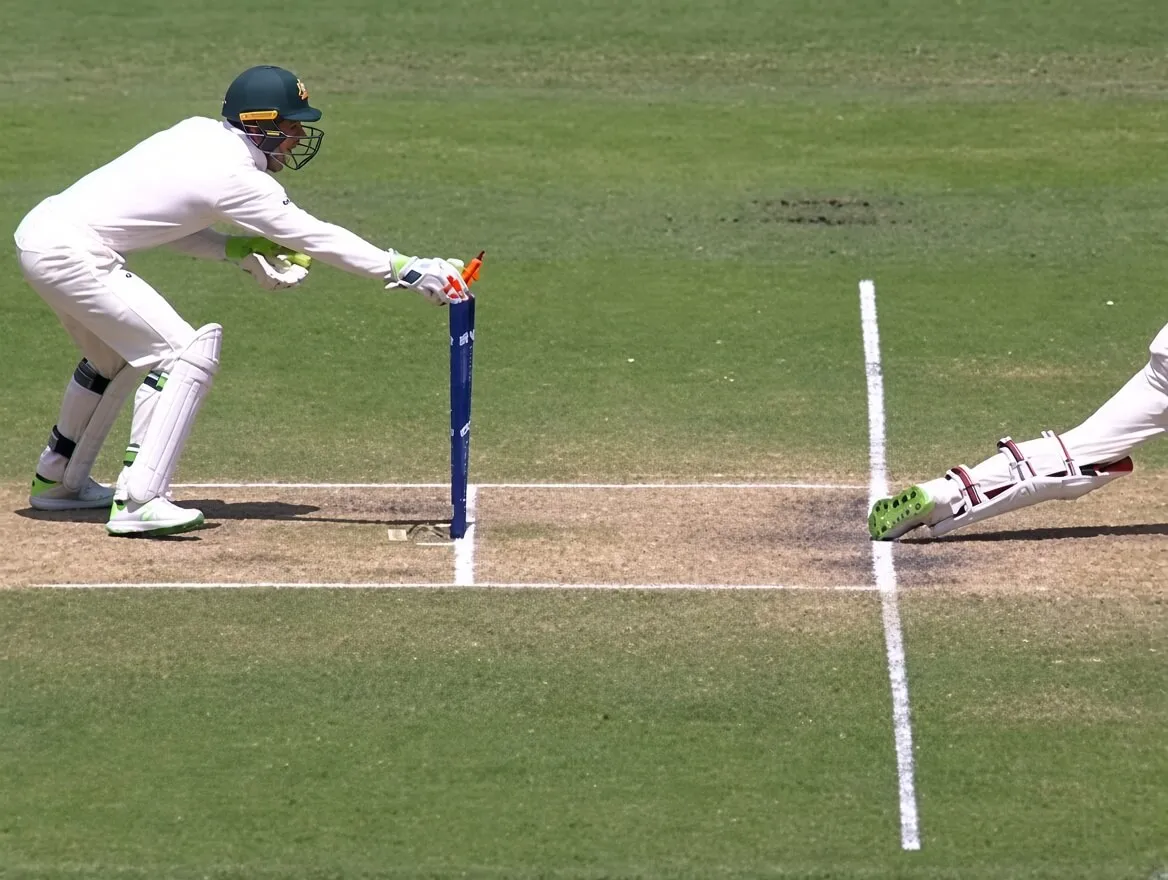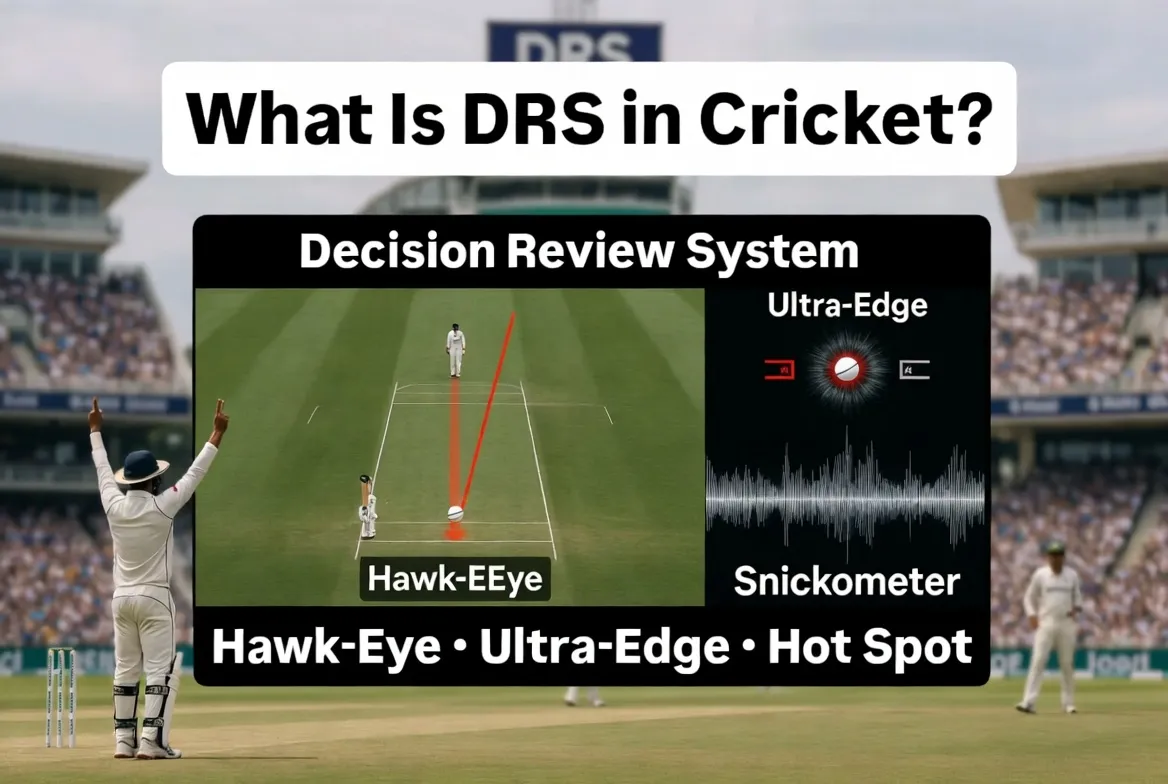
DRS stands for Decision Review System, the technology cricket uses to allow players to challenge on-field umpire decisions. Introduced in international cricket in 2008, DRS combines Hawk-Eye ball tracking, UltraEdge sound technology, and slow-motion video to verify whether a batter is out or not. Each team gets a limited number of reviews per innings. If the technology supports the on-field decision, the team loses a review. If it overturns the decision, they keep it. DRS has fundamentally changed how cricket is officiated, but it remains one of the sport's most debated systems. Here is exactly how it works.
How DRS Works: The Basics
When a batter is given out (or not out) by the on-field umpire and the captain or batter disagrees, they can signal a T-shape with their hands to request a review. The third umpire then uses several technologies to determine if the original call was correct.
Technology | What It Checks |
|---|---|
Hawk-Eye | Ball tracking to predict trajectory after pitching, especially for LBW decisions |
UltraEdge / Snicko | Audio detection of bat-ball contact (caught behind, edge to slips) |
Hot Spot | Infrared imaging to detect contact (used in some Test series) |
Slow-motion video | Frame-by-frame review of catches, foot positioning, no balls |
Ball-tracking projections | Predicts where the ball would have hit the stumps |
How Many Reviews Each Team Gets
Format | Reviews Per Innings |
|---|---|
Test cricket | 3 per innings |
ODI | 2 per innings |
T20 international | 2 per innings |
IPL / franchise leagues | 2 per innings (varies by tournament) |
If a review is successful (decision overturned), the team retains the review. If it fails (decision upheld), the team loses one review from their allocation.
The "Umpire's Call" Rule
The most controversial part of DRS. When ball-tracking shows the ball marginally hitting or missing the stumps, the original on-field decision stands. This is called "umpire's call".
For LBW reviews specifically:
Less than 50% of the ball hitting the stumps = umpire's call
More than 50% of the ball hitting the stumps = clear ball tracking decision
If the umpire said "out" and ball tracking shows umpire's call, the batter remains out
If the umpire said "not out" and ball tracking shows umpire's call, the batter remains not out
This rule respects the on-field umpire's judgment when ball tracking margins are small, but it means two identical deliveries can produce different outcomes based on the original call.
What DRS Can and Cannot Review?
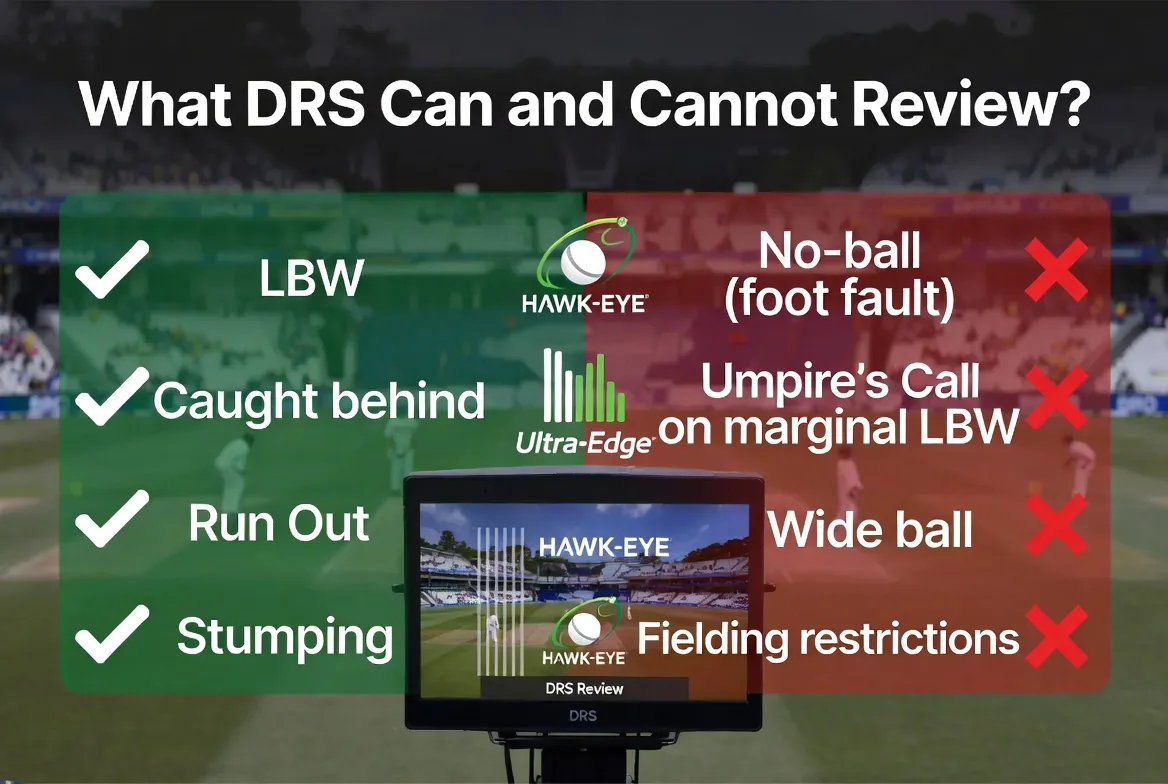
Can be reviewed:
LBW decisions
Caught behind (edges)
Caught in the field (whether the ball carried)
Stumpings and run outs (typically third umpire automatic)
No balls (now mostly automatic third umpire)
Boundary catches (foot on rope)
Bump balls (ball into ground vs caught cleanly)
Cannot be reviewed:
Wides called by the umpire
Decisions on whether a delivery is short-pitched intimidatory bowling
Code of conduct issues
How Hawk-Eye Predicts Ball Trajectory
Hawk-Eye uses multiple high-speed cameras placed around the ground to track the cricket ball at over 100 frames per second. Software then:
Records the actual path from the bowler's release to where the ball stopped or struck
Models the ball's velocity, spin, and bounce
Projects the trajectory forward to predict where it would have gone
For LBW reviews, the projection shows whether the ball would have continued on to hit the stumps. The accuracy is typically within 2.6 millimetres, though the system uses a 5mm margin of error in cricket applications.
From experience: Even at district-level cricket without DRS, you see how often LBW decisions split opinion. The on-field umpire has half a second to judge line, length, height, and impact. International umpires are exceptional, but even they get marginal calls wrong. DRS is not perfect, the umpire's call rule frustrates everyone at some point, but it has caught more genuinely incorrect decisions than it has created controversies.
Famous DRS Moments
2019 World Cup Final: Multiple critical reviews, including the controversial Stokes overthrow boundary, although that was not a DRS decision
2021 Border-Gavaskar Trophy: India successfully overturned several decisions in one of the most successful DRS series in history
Joe Root vs Australia, Edgbaston 2019: Multiple reviews showed how the umpire's call rule can swing matches
Criticisms of DRS
Inconsistent technology availability: Hot Spot is expensive and not always used in lower-tier series
Umpire's call confusion: Fans struggle to understand how the same ball-tracking projection can produce different outcomes
Review depletion: Teams sometimes lose all reviews early then face genuine errors with no remedy
Time consumed: Reviews can take 2-3 minutes each, slowing the pace of already long matches
Boundary catch reviews: Multiple frame analyses of feet on the rope can be inconclusive
How DRS Has Changed Cricket
Before DRS, decisions were final and umpire mistakes simply became part of the match. Now:
Captains strategise when to use reviews based on match situation
Bowlers appeal more confidently, knowing genuine wickets can be reviewed
Players communicate with batting partners about whether to review LBW decisions
Umpire pressure has reduced, since marginal calls can be checked
Match analysts track DRS success rates as a separate skill
Conclusion
DRS is cricket's most significant officiating change in the modern era. Combined with Hawk-Eye, UltraEdge, and slow-motion replays, it has caught countless wrongly given decisions. The umpire's call rule remains divisive, but the system overall has improved fairness. For batters, knowing when to review is now part of the skill set, just like reading the bowler. For bowlers, DRS validates good appeals and removes the frustration of clear wickets being missed. To see exactly how LBW reviews work and what the umpire and DRS check for, our detailed guide on what is LBW in cricket covers the rule in full, and our cricket formats explained guide covers how DRS use varies across Test, ODI, and T20.
FAQs
What does DRS stand for in cricket?
Decision Review System. It allows players to challenge on-field umpire decisions using ball-tracking, sound, and video technology.
How many DRS reviews does each team get?
3 per innings in Test cricket, 2 per innings in ODIs and T20Is. Reviews are retained if the original decision is overturned.
What is umpire's call in DRS?
When ball-tracking shows the ball marginally hitting or missing the stumps, the on-field umpire's original decision stands, even if the ball was clipping the stumps.
Is DRS used in all cricket?
It is used in most international matches and major franchise leagues (IPL, BBL, PSL, CPL). Lower-tier domestic cricket may not have full DRS due to cost.