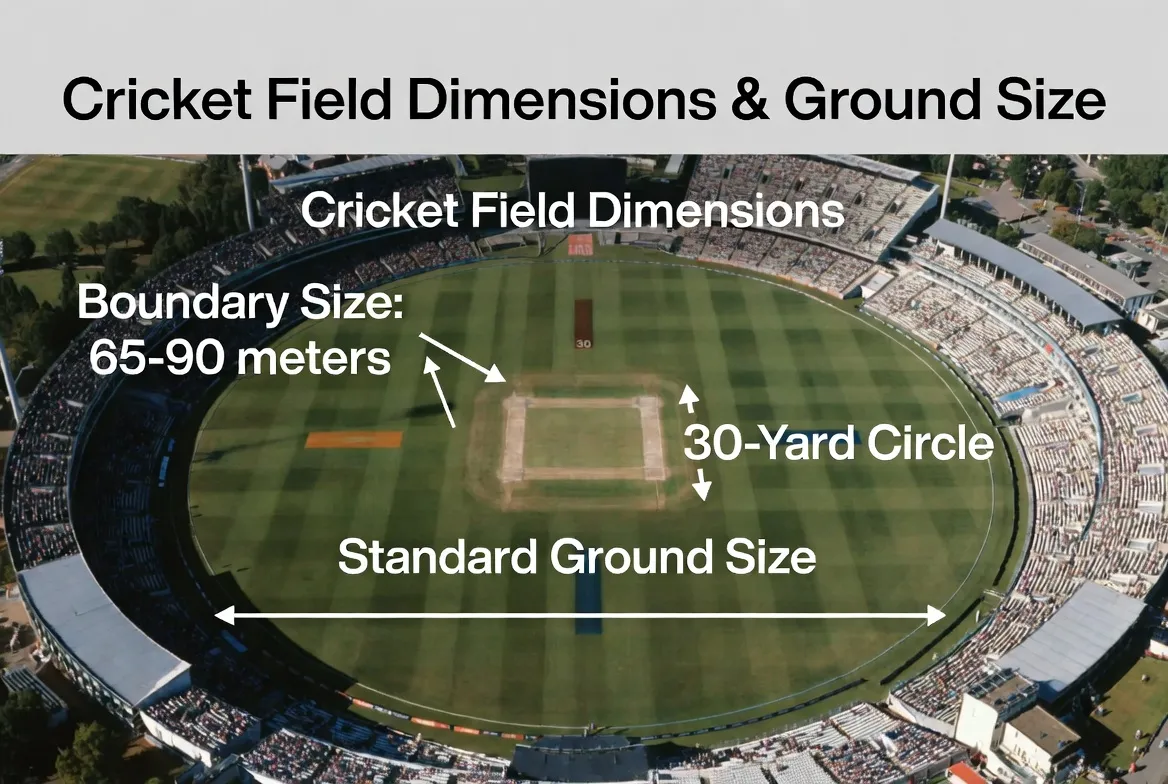
A cricket field is oval or roughly circular, with the boundary typically 137 metres to 150 metres in diameter at international venues. Unlike most sports, cricket has no fixed field dimensions. The Laws of Cricket only specify minimum and maximum boundary distances, leaving exact ground sizes to each venue. This is why one match might be played on a 65-metre boundary and another on 90 metres. Here is exactly how cricket grounds are measured, the markings on the field, and how dimensions affect strategy.
Cricket Field Dimensions at a Glance
Measurement | Standard / Range |
|---|---|
Boundary radius (centre to rope) | 59 m to 90 m |
Boundary diameter (full ground) | 120 m to 180 m |
30-yard circle radius | 27.4 m (30 yards) |
Pitch length (within the field) | 20.12 m (22 yards) |
Pitch width | 3.05 m (10 feet) |
Field shape | Oval or circular |
Unlike football pitches or basketball courts, cricket fields are not standardised. The MCC's Laws state only that the boundary must be at least 59 metres from the centre of the pitch to the boundary at the longest straight hit, with shorter side boundaries permitted.
The Boundary Rope
The outer edge of the playing field is marked by a thick rope laid on the grass, called the boundary. Some grounds use a painted line instead. A ball that touches or crosses the boundary scores:
4 runs if it bounces or rolls across
6 runs if it clears the boundary on the full
The rope is also relevant for fielding. If a fielder catches the ball but their foot touches the rope, it is automatically called a boundary, not a catch. This is why you see fielders parry the ball back into the air before stepping over the rope, then complete the catch after stepping back inside.
The 30-Yard Circle
A painted oval line surrounds the pitch at a radius of 30 yards (27.4 metres). This circle is critical in limited-overs cricket because it controls field placement during powerplays:
Powerplay 1 (overs 1-10 in ODIs): Only 2 fielders allowed outside the circle
Powerplay 2 (overs 11-40): Maximum 4 fielders outside
Powerplay 3 (overs 41-50): Maximum 5 fielders outside
T20 powerplay (overs 1-6): Maximum 2 fielders outside
T20 non-powerplay overs: Maximum 5 fielders outside
The circle does not exist in Test cricket because there are no fielding restrictions. Captains can set fully attacking or defensive fields without limits.
How Ground Size Affects Cricket?
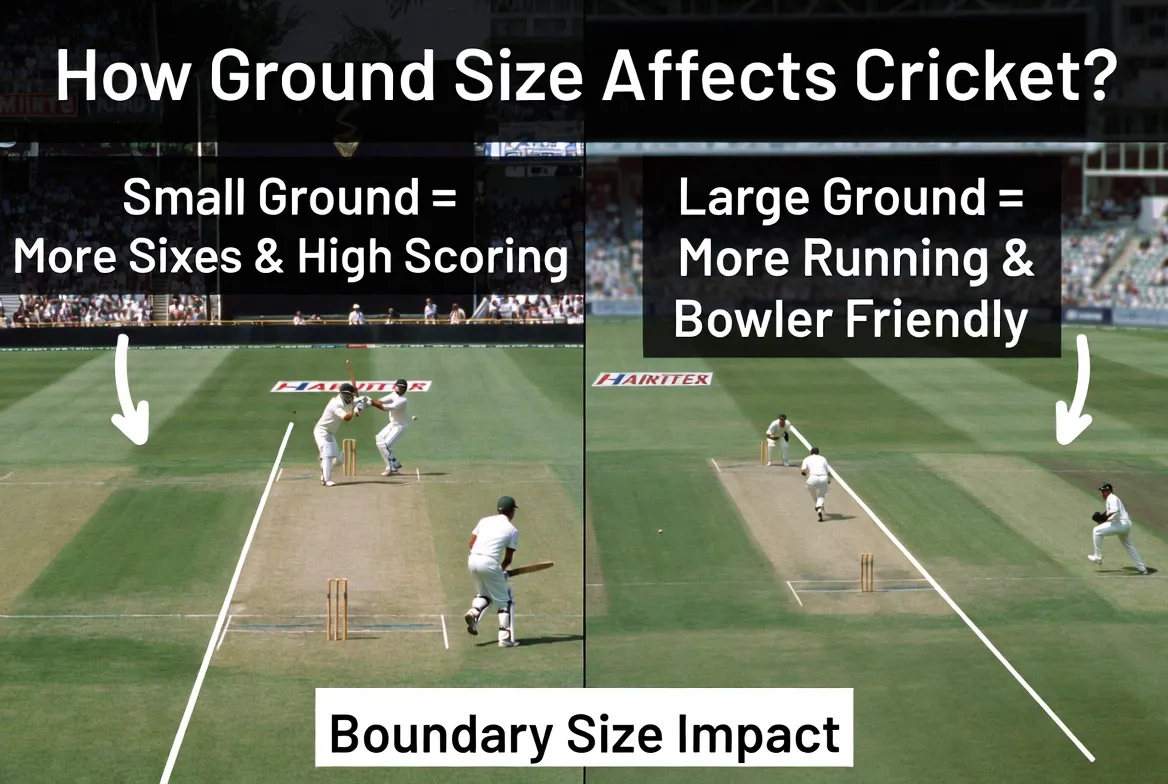
Because boundary lengths vary so widely, cricket grounds play very differently:
Ground Type | Typical Boundary | Effect on Play |
|---|---|---|
Large stadiums (MCG, Lord's, Eden Gardens) | 80-90 m | Harder to hit sixes, mistimed shots get caught |
Small grounds (Wankhede, Chinnaswamy) | 65-72 m | High scoring, more sixes, harder for bowlers |
Club cricket grounds | 50-65 m | Boundaries cleared regularly, attacking play favoured |
Backyard cricket | 10-20 m | Fence rules and out-of-bounds dominate |
This is why the same batter can dominate at one ground and struggle at another. Wankhede in Mumbai averages around 65 metres on the straight boundaries. The MCG can have boundaries of 86 metres straight. The same hit that clears one rope falls comfortably into a fielder's hands at the other.
Famous Cricket Grounds and Their Dimensions
Melbourne Cricket Ground (MCG): 173 m x 148 m. One of cricket's largest grounds
Lord's, London: 150 m x 138 m. The "Home of Cricket" with its famous slope
Eden Gardens, Kolkata: 137 m x 135 m. Iconic venue, often hosts massive crowds
Wankhede, Mumbai: 138 m x 132 m. Smaller dimensions favour aggressive batting
SCG, Sydney: 152 m x 138 m. Asymmetrical, tricky for fielders to gauge boundaries
Adelaide Oval: 187 m x 134 m. Famous for short straight boundaries and long square ones
From experience: Playing on different sized grounds genuinely changes how you bat. At our home club ground with short boundaries, batters could clear them with mistimed shots. When we played at the bigger district ground, the same shots became easy catches. Knowing the boundary distances before the toss is part of pre-match planning at every level above casual cricket.
Why Cricket Fields Are Not Standardised
Cricket grew from village greens and irregular pieces of land in 17th and 18th century England. There was no central authority to enforce a fixed shape, so each village simply played on whatever oval space was available. By the time cricket was formalised, the variation in ground sizes was already a feature of the sport.
The MCC has defended the variation as part of cricket's character. A team that wins at the smaller Wankhede must adapt to face the same opponent at the larger MCG. Tactics must change with the ground. This is uniquely a cricket challenge.
Pitch Within the Field
The pitch sits in the centre of the field, a 22-yard rectangle where bowling and batting take place. Most fielding action happens on the field around the pitch, not on the pitch itself. Fielders cannot stand on the pitch during delivery, the only people allowed on it during play are the bowler, the two batters, and the umpire.
For exact pitch measurements and crease markings, the rules of LBW directly relate to where the ball pitches and strikes the batter relative to the stumps.
Setting Up Cricket at Home or Club Level
For backyard or club cricket, you do not need a full international-sized ground. Workable dimensions:
Junior cricket fields: 40-50 m boundaries, 20-yard pitch (or shorter)
Club grounds: 55-70 m boundaries, full 22-yard pitch
Home practice areas: See our backyard cricket practice area guide for setup at home
The minimum is whatever space allows safe play, fair contest, and proper boundary scoring.
Conclusion
Cricket field dimensions are deliberately flexible, with boundary lengths from 59 metres to 90 metres, oval or circular shape, and the same 30-yard circle for fielding restrictions in limited-overs. Ground size affects strategy directly, smaller grounds favour batters, larger grounds reward fielding skill. The 22-yard pitch always sits in the centre regardless of how big the field is. To see how field dimensions affect the contest in different formats, see our cricket formats explained guide, and for the full match timing context our match duration guide covers how ground size influences over rates and play time.
FAQs
How big is a cricket field?
Boundaries are typically 59 to 90 metres from the centre. Most international grounds measure 137 to 180 metres in diameter. There is no fixed standard size.
What is the 30-yard circle in cricket?
The painted ring around the pitch at 27.4 metres radius. It controls fielding placement during powerplays in ODIs and T20s.
Why are cricket fields different sizes?
Cricket evolved on village greens with varied dimensions. The MCC kept the flexibility instead of enforcing standard sizes, which is now part of the sport's character.
What is the largest cricket ground in the world?
The Melbourne Cricket Ground (MCG) is the largest cricket ground by capacity (100,000+ seats) and has one of the longest boundaries at around 86 metres straight.